The books
Ledger
Double-entry accounting for money, credits and stock. It keeps our own books, and it is the same service we sell.
- Built on
- Auth, PostgreSQL
- Your data leaves as
- CSV and JSON
How we run
The books, the specifications, the bill of materials and SBOM, the commercial record and the mail all sit on systems we wrote and operate. Every platform we sell runs the company first, so a release that would break our own books breaks ours before yours.
The difference
Not a boast about building things. A statement of where the record lives, and who is accountable when it is wrong.
| Concern | Most organisations buy | We run |
|---|---|---|
| The books | An accounts subscription | Ledger |
| Specifications and change control | A hosted issue tracker | Tracker |
| Bill of materials and SBOM | A spreadsheet, or nothing | Provenance |
| The commercial record (CRM) | A sales subscription, separate from the accounts | Trace |
| Documentation and runbooks | A documentation subscription | Knowledge base |
| Company email | A mail and office subscription | Webmail |
Every system above is built, deployed and running on its own database. Checked 2026-09-09.
The systems
Each owns one concern, authenticates against our own identity service, keeps its own database, and can hand its data back in an open format.
The books
Double-entry accounting for money, credits and stock. It keeps our own books, and it is the same service we sell.
Specifications and change control
Every change to every repository begins as a written specification and a ticket, and closes with a note of how it was verified.
Bill of materials and SBOM
An asset register for the hardware, an SBOM for every software release we ship, and security findings tracked against both.
The commercial record (CRM)
Customer relationship and revenue records, reconciled against the ledger rather than kept alongside it, so the two cannot quietly disagree.
Documentation and runbooks
Where every platform on the estate writes its own documentation, so the runbook for a service is not in one engineer’s head.
Company email
A mailbox interface over our own mail platform, so company correspondence stays on infrastructure we operate.
Inside
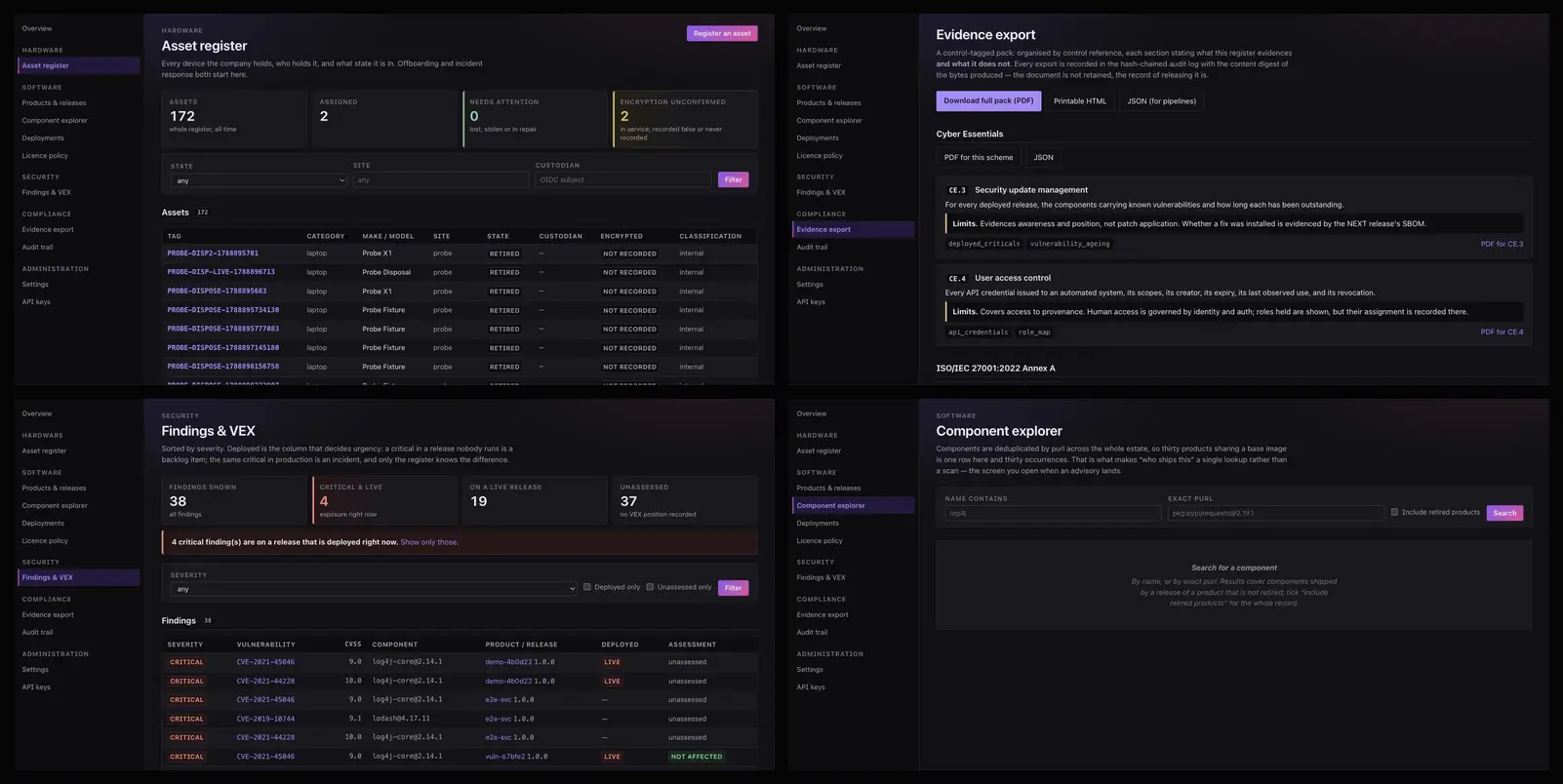
Four screens from Provenance: the hardware asset register, the evidence pack organised by control reference, the findings table with its VEX positions, and the component explorer.
The obvious question
Because for most of this, buying it is the part that would not make sense.
The ledger that keeps our books is a product on this site. Paying someone else for the thing we sell would be the odd decision, and running it ourselves is how we find out what a release does to a real set of books.
A component inventory and security findings across our own estate, in CycloneDX, SPDX and VEX, is not something a small supplier can subscribe to. Most answer that question with a spreadsheet. We built the register instead.
Everything above sits on PostgreSQL, FreeBSD, Python, OpenID Connect and Publicly trusted TLS. We write the application layer. We do not write databases, operating systems or cryptography, and we would not ask you to trust us if we did.
The fair objection to a company that runs its own systems is what happens when the people who built them are unavailable. The answer is written down rather than asserted: every repository carries its own runbook, every change carries a specification and a ticket that records how it was verified, database migrations live inside the database they manage so they survive a restore, restores are exercised end to end rather than assumed, and the whole estate is described in a published topology.
How it holds together
Read a row left to right: the concern, the system that owns it, and the platforms from our own catalogue underneath it.
The books
Ledger
Auth, PostgreSQL
Specifications and change control
Tracker
issuedb-cli + EARS, Identity
Bill of materials and SBOM
Provenance
Auth, PostgreSQL
The commercial record (CRM)
Trace
Ledger, Auth
Documentation and runbooks
Knowledge base
Auth, TokenGate
Company email
Webmail
Rodmena Mail API, Identity
The right-hand column is our own product catalogue. That is the whole argument on this page: the platforms we ask you to buy are the ones we depend on to invoice, ship and keep records. See how the platforms fit together.
We can walk through any of these systems, or hand over the topology, the policies and the capability statement for a procurement pack.